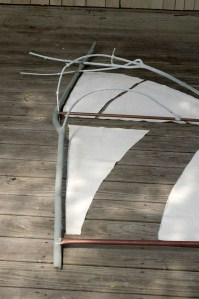
All three trellises have finally been assembled. Here are photos of the completed structures.


Tomorrow is the day to move the trellises to their new positions. I’ll post photos of those views.
All three trellises have finally been assembled. Here are photos of the completed structures.
Tomorrow is the day to move the trellises to their new positions. I’ll post photos of those views.
The other day, Suzanne and her mother and I spent the afternoon at the Nelson-Adkins Museum. At one point, I was looking at the big Franz Kline the NA has in its new Bloch wing and my mother-in-law asked me what I saw in the painting. Now, these days, mostly what I look at is technique. How did the artist create the image? How did she apply the paint? What sort of brush-strokes did he use? Did she change her mind about parts of the canvas?
I pointed out to my mother-in-law a couple of area of the Kline that looked like they had been painted over, white-over-black, and I showed her which brush stroked looked like they had been applied first and which one were done later. I don’t know if Kline considered some of the over-painted areas as mistakes or simply a change in direction, but I know that occasionally, I make a mistake in my art. For example, I made a big one right off the bat in siting my Trellises.
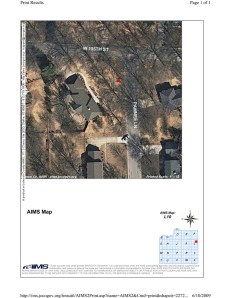
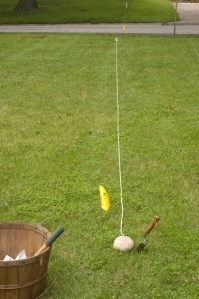
My plan for locating the three trellises was to use a grid of my front yard divided into 28 5′ x 5′ squares. On paper, it looked correct, but when I developed the grid on the ground, I used 10′ x 10′ squares instead of 5′ x 5′ squares. So, my first trellis was ten feet off. I realized what I had done when I started to site the second trellis, but I made the decision to leave the first one in the wrong spot; after all, I am nothing if not flexible with this project and it will make the flower/bulb/shrub beds in that area a bit more serendipitous.
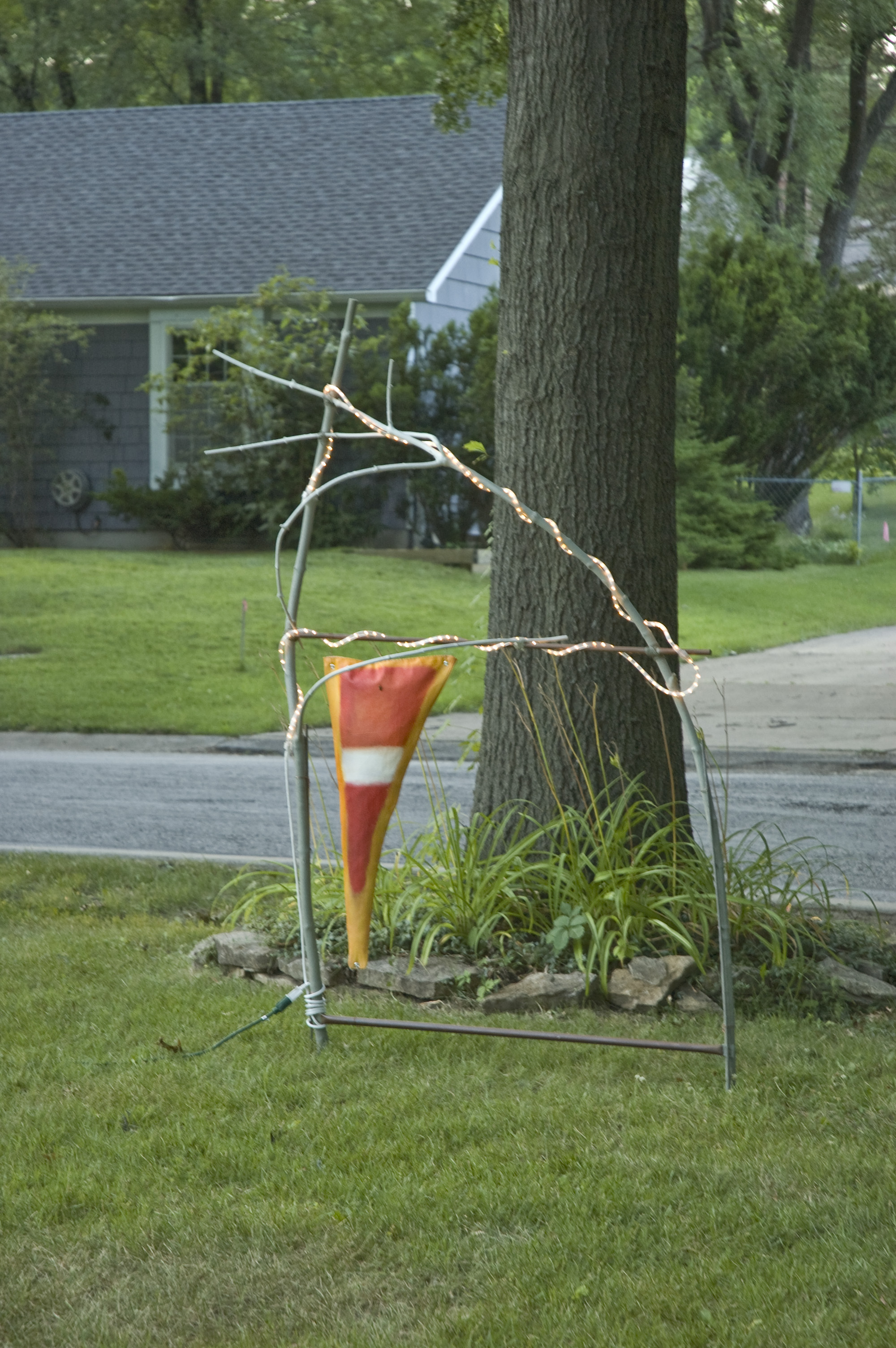
Here are some photos of the trellises in situ. Click on a photo for a larger view.



I’ll have more photos of canvases installed in a few days.
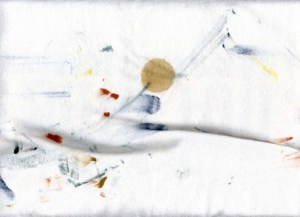
I promised to show some photos of my progress in getting the canvases painted. Here are a few shots of the process.


I first prepared the canvases by covering them with gesso and then began painting. I’m using my dogs’ room since it has a nice linoleum floor that cleans up well and they don’t seem to mind having their space intruded upon.


After I completed one of the canvases, I tried sewing the end together on the machine, but as I indicated in an earlier post, I ran into a problem with the thickness of the material. So, I’m stitching them by hand at this point. After the sewing is completed, I add grommets at the corners to attach the canvas to the trellis.
The three trellises have been installed, though without much canvas. I’ll be adding the canvases over the next several days. The problem with the sewing machine slowed me down. But the three structures went up today; I’ll have photos tomorrow. It was exciting to actually do the siting of the pieces, calculating the square locations and finding the orientation.
I’ve been painting a lot over the last few days. Listening to Phillip Glass and John Adams has put me in a Rothkovian mood, with a little Franz Kline and Alexander Calder thrown in. I took some time the other day to do some reading… a short biography of Alexander Calder. He’s long been a favorite of mine. Back in the 70s, I bought a signed-in-plate print of one of his pieces for $60 from American Express, of all places. I recently saw the same piece offered on eBay for $850.
Last night, I started to finish off one of the canvases I completed on Monday. I stuffed it with plastic grocery bags and tried to sew it closed, but the four layers of canvas were too much for the sewing machine and the needle bent and broke. I suppose the fact that it was probably at least forty years old had something to do with it. I went to a fabric store today and bought three heavy duty needles, manufactured for denim and canvas, so we’ll see how they do.
I’m going to be installing the trellises tomorrow, with a few of my canvas panels. I spent some time putting together a table with the randomly-selected squares in the grid and will do the orientation selection for all of them later on today. There are fourteen weeks between now and the end of the project. I’ll be moving the trellises every two weeks. There are 28 squares in my grid and with a total of 21 locations for the three trellises, so the odds of some repeats were pretty high. As it turns out, seven of the 28 squares will be used twice.
Tomorrow, I should have some photos to include of the trellises in place.
One of the casualties of this project has been my time for reading. A few weeks ago, I started “Swann’s Way,” the first book of Marcel Proust’s monumental novel/memoir, “In Search of Lost Time.” I had managed to make it through the first chapter when I started thinking about/constructing the trellises. Proust is not what is now colloquially called an “easy read.” It is dense, chocked full of literary references and comprised of complex, multi-part sentences that I can imagine Barack Obama would construct in answer to a Fox News reporter’s questions, leaving the reporter dazed and confused.
I started reading Proust not because I’ve always wanted to read Proust or because I thought that I should read Proust (although I find myself more and more thinking about all the books I think I should have read in order to be a somewhat literate person… all of Shakespeare, not just the popular plays; more of the Greeks; get through Ulysses, after three or four starts; Tolstoy, Dostoyevski; the Koran, etc), but because I read a review of a book entitled “Paintings in Proust” by Eric Karpeles. Karpeles managed to track down all the references to art in seven novels and get permission to reproduce them. It is an amazing book, with each image accompanied by the fragment of text from the novel in which the painting is reference and a commentary on the progress of the novel. Alas, I haven’t had time to read that book either.
Well, the trellises will be installed in about a week and I’ll be able to get back to Proust and a book about the WPA that I started in February; “New Art City” about New York in the era of de Koonig, Pollock, Kline, and Hoffman; and, the American avant garde in the 1920s called “Strange Bedfellows.” I always have several books going at the same time, it seems.
After repairing the sewing machine and finding a copy of the manual on-line, I started learning to use it. Sure wish I had taken home ec in high school! I can’t imagine how I’d be getting along right now if I hadn’t taken typing, then. You never know what’s going to come in handy in your life, especially when you are seventeen years old. I marvel at the kids who have already figured out that they are going to become pediatricians or accountants or morticians. At seventeen, I barely had enough sense to get out of bed in the morning, so how did I figure out that it was a good idea to take typing?
Well, back to sewing. I’m pretty good at following directions, so I was able to load the bobbin, thread the needle and begin practicing sewing. Getting the tension right between the needle thread and the bobbin thread was a challenge. The manual shows how a correct stitch is supposed to look; none of mine looked that way for the first hour. The needle thread was either too tight or the bobbin thread was too tight. I just said that I was good at following directions, but there was one that I missed that made all the difference: you are supposed correct the needle tension with the presser foot lowered. I kept trying to set the tension with the foot up. When I discovered what I was doing, it only took another thirty minutes to adjust it! Not only do I follow directions well, I’m also patient.
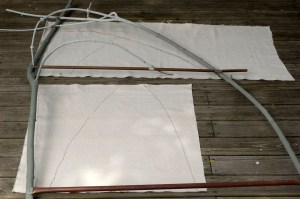
This project is all about flexibility and improvisation, so I’ve made another adjustment to how the canvases are going to be displayed. Originally, I thought I would just hem the edges of the pieces and attach grommets, but I decided that might not be secure enough. After some deliberation, I decided to cut two pieces of canvas for each shape that will be on the trellises and create pillow-like objects: three-dimensional “sculptures” instead of just flat, two-sided paintings. I’m planning to stuff the pillows with the millions of plastic grocery bags that we accumulate and with the packing peanuts we’ve saved from previous moves. I knew those would come in handy eventually.
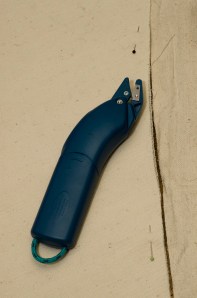
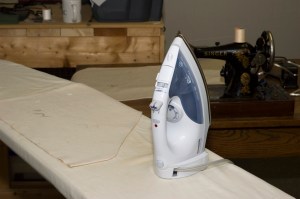
After cutting all the additional pieces, I started sewing then together. Here is a photo of cutting and one of sewing. I also pressed each piece so it would provide a smooth surface for the painting, which will be done before I stuff the pillows.

I started preparing the canvases last night by gessoing them. If you aren’t familiar with the term “gesso” you can go to that all-purpose, pseudo encyclopedia, Wikipedia, to find out more than you could possibly want to know about it. Here’s the link:
http://en.wikipedia.org/wiki/Gesso
As the painting progresses, I’ll add photos.
Peace
It’s actually been over a week since my last post and a lot has taken place since then. Probably most important among the changes, I’ve rename the project from “Of fence” to “Trellises.” When I first conceived this venture, I was looking at the three pieces to be grouped and moved together as “a sort of fence.” As I began constructing the three trellises, however, I came to see them less as a connected unit and more as individual entities that need to move on their own. Hence, the fence has ceased to exist and the trellises have emerged.
Another reason for the renaming: a trellis is usually a free-standing structure which supports fruit trees or upon which vining plants climb. Not only are the trellises I’ve constructed meant to stand on their own (at least I hope they do, literally and figuratively), but they are also the structures which will support my painted canvases (the fruit of my creativity?). Additionally, trellis is an appropriate title since I am erecting three structures and the word trellis derives from the Latin trilix which is a shortening of tri- (three) and licium (to warp thread). Some parts of the three trellises have been bent or warped, so I’m honoring the spirit of the word.
Other things that have taken place:



 Let the waters come...